 RMS Queen Mary first sailed across the North Atlantic on May 27, 1936. At the time she was one of the largest ocean liners.
Now she lives in "retirement" as a tourist attraction in Long Beach, California (USA) where I took this photo yesterday.
RMS Queen Mary first sailed across the North Atlantic on May 27, 1936. At the time she was one of the largest ocean liners.
Asian Medicine/AcupunctureThis is pseudoscience and quackery. The University of Toronto should not be lending its implicit stamp of approval to such nonsense.
Students learn about the philosophy and principles of Asian medicine: Yin and Yang theory, the meridians and channels system, the five-element theory and the symptoms and signs involving the 12 master meridians. Applying these principles in the context of patient assessment and treatment is emphasized, with acupuncture and therapeutic botanicals being the main approaches.
Homeopathic Medicine
The history, principles and philosophy of homeopathy are discussed in depth. Practical application of homeopathic principles in patient assessment and management is emphasized for acute and constitutional cases. Skills are developed in case analysis, repertorization, materia medica search, remedy differentiation and selection and prescribing the appropriate posology.
 Back in the late 1980's, I read Molecular Evolutionary Genetics by Masatoshi Nei. He introduced me to the concept that the history of life is driven by mutation and that the old-fashioned view of mutationism needs to be looked at more carefully. A decade later, Arlin Stoltzfus took up the cause and he has published a number of papers on the topic.
The purpose of this book is to present a new mechanistic theory of mutation-driven evolution based on recent advances in genomics and evolutionary developmental biology. The theory asserts, perhaps somewhat controversially, that the driving force behind evolution is mutation, with natural selection being of only secondary importance. The word 'mutation' is used to describe any kind of change in DNA such as nucleotide substitution, gene duplication/deletion, chromosomal change, and genome duplication. A brief history of the principal evolutionary theories (Darwinism, mutationism, neo-Darwinism, and neo-mutationism) that preceded the theory of mutation-driven evolution is also presented in the context of the last 150 years of research. However, the core of the book is concerned with recent studies of genomics and the molecular basis of phenotypic evolution, and their relevance to mutation-driven evolution. In contrast to neo-Darwinism, mutation-driven evolution is capable of explaining real examples of evolution such as the evolution of olfactory receptors, sex-determination in animals, and the general scheme of hybrid sterility. In this sense the theory proposed is more realistic than its predecessors, and gives a more logical explanation of various evolutionary events.I can't wait to get my hands on a copy of this book. Look for a review in a few months.
Mutation-Driven Evolution is suitable for graduate level students as well as professional researchers (both empiricists and theoreticians) in the fields of molecular evolution and population genetics. It assumes that the readers are acquainted with basic knowledge of genetics and molecular biology.
 Let's look at a recent post on Evolutin News * Views (sic): From Discovering Intelligent Design: Opposition from the Scientific Establishment. As the title suggests, this is an excerpt from one of the books being heavily promoted by the IDiots.
ID challenges a reigning scientific paradigm. But as sociologist Steve Fuller says, ID is not anti-science, but rather anti-establishment. ID theorists want more scientific investigation, not less. They simply want the freedom to follow the evidence without harassment or philosophical restrictions.Let me remind you that the presence of junk DNA in our genome was not anticipated by those who believed in the importance of natural selection. What happened was that the evidence became too substantive to ignore so scientists had to accept the presence of junk DNA in spite of the fact that most of them expected selection to eliminate it.
An ID-based view of science promises to open new avenues of scientific investigation. Without materialist paradigms governing science, perhaps more scientists would have sought function for structures like "junk" DNA and vestigial organs, rather than assuming they were non-functional evolutionary relics.
 I've always been a bit embarrassed to admit that my own department doesn't adopt my textbook in their introductory biochemistry courses. The honors course uses the 4th edition of Voet & Voet but it's only "recommended," not required. The large introductory course for non-specialists recommends several textbooks, including mine.
  Some economist named George Gilder has read Darwin's Doubt, the latest IDiot book. Gilder says ...
I spend my life reading science books. I've read many hundreds of them over the years, and in my judgment Darwin's Doubt is the best science book ever written. It is a magnificent work, a true masterpiece that will be read for hundreds of years.See David Klinghoffer gloat about this at: George Gilder: Darwin's Doubt Is "Best Science Book Ever Written," "Will Be Read for Hundreds of Years".
 Last Monday I went back to my old high school (Nepean High School in Ottawa, Canada) to visit with students in various biology classes. My host was Susanne Gerards who teaches grade 11 biology and grade 12 biology. She's also the lead author on the biology textbook [Biology 12] that the students use in the grade 12 courses.
 The students were wonderful. Many of them are going to take science courses in university. (They all had their university acceptances.) Only a few of them are interested in medicine.1
 1. Hardly any of them were going to the University of Toronto in spite of the fact that it's the best university in Canada. I'm not sure why they were avoiding it. The most popular universities were Queen's, McGill, and Waterloo.
 The so-called "C-Value Paradox" was described over thirty years ago. Here's how Benjamin Lewin explained it in Genes II (1983).
The C value paradox takes its name from our inability to account for the content of the genome in terms of known function. One puzzling feature is the existence of huge variations in C values between species whose apparent complexity does not vary correspondingly. An extraordinary range of C values is found in amphibians where the smallest genomes are just below 109bp while the largest are almost 1011. It is hard to believe that this could reflect a 100-fold variation in the number of genes needed to specify different amphibians.Since then we have dozens and dozens of examples of very similar looking species with vastly different genome sizes. These observations require an explanation and the best explanation by far is that most of the genomes of multicellular species is junk. In fact, it's the data on genome sizes that provide the best evidence for junk DNA.
 It's not difficult to find a proper definition of evolution. All you have to do is check your basic introductory textbooks on evolution. Google is not your friend in this case 'cause there's a lot of misinformation out there. If you're really interested in a scientific definition of evolution why not go right to the primary source?
Evolution is a process that results in heritable changes in a population spread over many generations.Now, we all know that Intelligent Design Creationists are keen on real science. They certainly don't want to mislead their flock. Let's see how they define evolution in the latest book they are promoting [From Discovering Intelligent Design: Define Your Terms].
The modernization of science education requires a shift from a content-driven curriculum to an interdisciplinary, concept-driven curriculum (Association of American Medical Colleges and Howard Hughes Medical Institute, 2009; American Association for the Advancement of Science, 2009; National Research Council, 2003, 2009). Such a curriculum organizes information around unifying concepts and frees educators from the insurmountable task of presenting the complete breadth of an ever-expanding scientific knowledge base (D’Avanzo, 2008). Concept-driven education is increasingly seen as fundamental for contemporary research scientists and physicians (Association of American Medical Colleges and Howard Hughes Medical Institute, 2009).
1. After sending me a copy.

[Photo credit: CBC News]
Dear Professor Moran: I hope you don't mind my writing to you, but I just came across your blog, Sandwalk after doing some research about blood types and wondered if you might have an opinion....If high school teachers aren't knowledgeable enough to handle these situations then they should avoid these "experiments."
My daughter, in 7th grade is working on a blood type project at school and came home quite upset yesterday after telling the teacher that she was type A+ and both her Dad and I are O+. The teacher (whom I have not yet dragged over hot, burning coals....) told her that that was impossible - that she would either have to have been adopted or have a genetic defect.... It got me thinking that perhaps I had made a mistake somewhere along the way and we spent some time last night digging through info to try to figure it out. I checked with our doctors this morning and our daughter's pediatrician and all blood types have been confirmed. Both my husband and I are O+ and our daughter is A+ She is definitely not adopted and unless she was switched at birth, then there is no doubt as to parentage -- should I be concerned? I do recall that when she was born she had mild jaundice which one doc explained was due to blood type incompatibility.
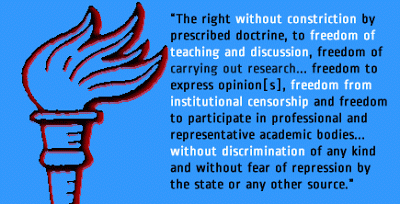 Jerry Coyne has discovered that some obscure Professor in some American college is teaching from a Christian viewpoint in his class on "The Boundaries of Science." Jerry thinks that he can stop this Professor from teaching things that he (Coyne) disagrees with by threatening the university with a lawsuit. PZ Myers and I disagreed, pointing out that academic freedom in the universities is an important principle that should not be ignored [see Is It Illegal to Teach Intelligent Design Creationism in American Universities?].
CAUT actively defends academic freedom as the the right to teach, learn, study and publish free of orthodoxy or threat of reprisal and discrimination. Academic freedom includes the right to criticize the university and the right to participate in its governance. Tenure provides a foundation for academic freedom by ensuring that academic staff cannot be dismissed without just cause and rigorous due process.I have defended the academic freedom of racists and holocaust deniers in the past. I've even defended the right of an extreme free-market capitalist to indoctrinate business students. In the name of academic freedom, I will even tolerate adaptationists who teach evolution incorrectly.

 I was reading the latest spiel from Sal Cordova (scordova) when I noticed a reference to Michael Denton. Cordova was ranting about how Taxonomic nested hierarchies don’t support Darwinism and he began with ...
Taxonomic nested hierarchies don’t support Darwinism or common descent, actually the opposite. Michael Denton convincingly argued that nested hierarchies can be used to argue against macro evolution. If the fish are always fish, then they will never be birds, reptiles, apes, or humans.I knew that this was a misrepresentation of Denton's views since he (Denton) supports the idea that nested hierarchies represent the true history of common descent.
If it is true that a vast amount of the DNA in higher organisms is in fact junk, then this would indeed pose a very serious challenge to the idea of directed evolution or any teleological model of evolution. Junk DNA and directed evolution are in the end incompatible concepts. Only if the junk DNA contained information specifying for future evolutionary events, when it would not in a strict sense be junk in any case, could the finding be reconciled with a teleological model of evolution. Indeed, if it were true that the genomes of higher organisms contained vast quantities of junk, then the whole argument of this book would collapse. Teleology would be entirely discredited. On any teleological model of evolution, most, perhaps all, the DNA in a genome of higher organisms should have some function. (pp. 289-290I wonder what Intelligent Design Creationists think of this argument?

