More Recent Comments

Thursday, April 14, 2011

Do Not Vote for the Anti-Science Green Party


There is no party platform that perfectly reflects my views on all issues. However, there is one thing I look for when deciding to support a political party and that's how they arrive at a particular policy. Is it scientific? Does the policy depend on evidence, healthy skepticism, and rational thinking?

The Green Party of Canada has outlined their platform in a document called Vision Green. Here's what they say in the introduction ...
Vision Green presents a well-researched analysis of critical environmental, economic and social challenges facing Canadians from coast to coast to coast, and presents practical solutions that can be achieved if there is the political will and leadership to take forward-looking action. It was developed by our Green Cabinet and was informed by experts, activists and citizens who participated in policy workshops held across Canada. Our vision is based on policies approved by the membership of the Green Party.
Sound promising. They don't actually say that their policies are based on sound scientific reasoning but it sounds like "well-researched" might be a synonym for "good science."

As you scan this document you encounter many positions that seem somewhat dogmatic and considerably beyond what the scientific evidence actually says. The Green Party is opposed to genetically engineered organisms, for example, and they propose to, "Phase out the use of genetically modified food products and ‘terminator’ seeds" (p. 74).

The Green Party is opposed to nuclear power and advocates a ban on new nuclear power plants and a shut-down of existing ones. The party proposes to ban uranium mining and refining. While some of their arguments are valid, the overall tone does not sound scientific.

But the real give-away comes when the document discusses health care. Here's one of the promises from page 70.
Provide funds to expand provincial health insurance to cover proven alternative therapies that are less expensive and invasive such as chiropractic, massage, acupuncture.
It is simply not true that these "alternative therapies" are proven in any scientific sense. What this tells me is that the Green Party platform is not based on scientific reasoning.

That's disappointing.

Everybody wants to promote good health. It's a motherhood issue. What's important is whether a political party has a realistic policy to achieve this goal. Most don't but the Green Party actually makes things worse ...
Health promotion is about more than health care or health education. It is about recognizing the profound health impacts of determinants of health outside the formal healthcare system and working with many stakeholders (policy-makers, NGOs, health agencies, multiple levels of government, the private sector, and most important, affected communities themselves) to reduce, eliminate, or overcome those factors that harm health or act as barriers to health enhancement, and to promote those factors that enhance the health, well-being and quality of life of all Canadians.

We will promote complimentary health care – through support of chiropractic, naturopathic, homeopathic, and other non-western practices. The Green Party of Canada recognizes the value of good health as a fundamental human right, and also the key to the most vibrant, inclusive and sustainable Canadian society possible.
I will never vote for a political party that promotes naturopathy and homeopathy in such a prominent manner. Naturopathy and homeopathy are examples of anti-science quack medicine. The fact that the leaders of the party would even include this in their platform tells me that scientific thinking is not part of their worldview and it calls into question their positions on everything else.

The Green Party wants to use my tax dollars to support these quacks.
Expand healthcare coverage to include qualified complementary/alternative health professionals such as naturopaths, acupuncturists, homeopaths, licensed massage therapists, chiropractors, and dietitians.
This is very wrong.

Do not vote for the Green Party. If you want to cast a protest vote then spoil your ballot or vote for some other party that cannot be elected in your riding. Every vote for the Green Party is a vote against science.


[Hat Tips: Zak at Canadian Atheist: The Green Party Platform and Mitchell Gerskup at Skeptic North: Voting Green? Read This.]

Monday, April 11, 2011

Hunting and Gathering in Washington D.C.


Laurel Kartchner is a Biochem/MCB major at the University of Arizona. She is attending the Experimental Biology 2011 conference in Washington.

Laurel visited all the display booths and collected all the available free loot. Here's her collection. Congratulations, Laurel!


Her poster will be up tomorrow ...
Kartchner, L.B., Malinowski, P., and T-S.Tsao Role of glutathione S-transferase and endoplasmic reticulum chaperone DsbA-L in the assembly of adipocyte hormone adiponectin.


Friday, April 08, 2011

Storm


This video is posted everywhere. In case you haven't watched it before you should do so right now. It's brilliant.

Imagine that you're at a dinner party and someone announces that all knowledge is relative, alternative medicine is better than real medicine, and science relies on faith—just like religion. That's the situation Tim Minchin found himself in. Here's how he struggled to keep quiet but eventually .....


Guess Who I'm Voting For?


Thursday, April 07, 2011

Springtime in Washington


I'm off to Washington D.C. on Saturday to attend the American Society for Biochemistry and Molecular Biology (ASBMB) 2011 Annual Meeting [ASBMB]. It's part of a larger meeting called Experimental Biology 2011.

One of the reasons for going is to get together with the other members of the editorial board of the Biochemistry and Molecular Biology Education journal [BAMBED].Many of them are fellow textbook authors.

There's going to be a wild party on Sunday night when we all get together to talk about the citric acid cycle and free energy.

I should have recovered by Monday noon in case anyone in the Washington area wants to meet up for some more exciting discussions about biochemistry and molecular biology.


Jonathan, Moonies, and Junk DNA

This video is supposed to support the evolution side versus the Intelligent Design Creationists. There are two major flaws in this presentation.

First, it spends too much time on the background of Jonathan Wells. While it's interesting to know where he's coming from, his motives are less important that the "scientific" case he's making. His religious motivation explains WHY he gets the science wrong but the important point is that the science IS wrong.

Second, it does a poor job of explaining the actual scientific controversy over the amount of junk DNA in our genome. It almost seems to imply that scientists don't believe in junk DNA.

This is a complicated issue. I don't expect the IDiots to get it right but I do expect scientists to explain it correctly.


IDiots vs Francis Collins

Here's a video where several IDiots take on Francis Collins and his book The Language of God,. Jonathan Wells is prominently featured in this video and much of the attack is concerned with junk DNA. Wells makes his position very clear. He claims that modern scientific evidence has overthrown the "myth" of junk DNA and those of us who still believe in junk DNA are guilty of a "Darwin of the gaps" kind of argument. That's because, according to Welles, we don't have an explanation for junk DNA therefore we attribute it to Darwinian evolution (6.00 minute mark).

There is a lot of positive evidence that much of the DNA in our genome is non-functional. Wells is dead wrong about this. Furthermore, assuming that this junk DNA is non-functional and assuming that species share a common ancestor, we can explain many observations about genomes. IDiots can't do this. They have yet to provide an explanation for shared pseudogenes1 in the chimp and human genomes, for example. And I haven't heard any IDiot explain why the primate genomes are chock full of Alu sequences derived from a particular rearranged 7SL RNA sequence while rodent genomes have SINES from a different rearranged 7SL sequence and lots of others from a tRNA pseudogene [Junk in Your Genome: SINES].


Did Francis Collins use the existence of junk DNA as support for Darwin's theory of evolution? Here's what Wells says in the video (50 second mark).
If fact he relies on so-called junk DNA—sequences of DNA that apparently have no function—as evidence that Darwin's theory explains everything we see in living things.
I searched in the The Language of God for proof that Wells is correct. The best example I could find is from pages 129-130 where Collins describes the results from comparing DNA sequences of different organisms. He points out that you can compare coding regions and detect similarities between humans and other mammals and even yeast and bacteria. On the other hand, if you look at non-coding regions the similarities fall off rapidly so that there's almost no similarity between human DNA and non-mammalian genomes (e.g. chicken). This is powerful support for "Darwin's theory of evolution" according to Francis Collins. First, because you can construct phylogenetic trees based on DNA sequences and ...
Second, within the genome, Darwin's theory predicts that mutations that do not affect function (namely, those located in "junk DNA") will accumulate steadily over time. Mutations in the coding regions of genes, however, are expected to be observed less frequently, since most of these will be deleterious, and only a rare such event will provide a selective advantage and be retained during the evolutionary process. That is exactly what is observed.
I leave it as an exercise for Sandwalk readers to figure out how to explain this observation if the regions that accumulate fixed mutations aren't really junk but functional DNA. Your explanation should consist of two parts: (1) why the DNA is functional even though the sequence isn't conserved (provide evidence)2, and (2) why coding regions show fewer changes and why comparisons of different species lead to a tree-like organization.

I wasn't able to find where in Origin of Species Darwin discuss this prediction but I'm sure it must be there somewhere. Perhaps some kind reader can supply the page numbers?


1. Every knowledgeable, intelligent biologist knows that pseudogenes exist and they are junk. That's not in dispute. I haven't heard any Intelligent Design Creationists admit that there are thousands of functionless pseudogenes in our genome.

2. I can think of two or three possibilities but no evidence to support them.

Monday, April 04, 2011

Toronto Skeptics in the Pub


Join us on Friday, April 15, 2011 at the Fox & Fiddle, 27 Wellesley St., Toronto for an event sponsored by the Association for Science and Reason (ASR).

The speaker will be me and the subject is The Accommodationist Wars.


What Is Intelligent Design Creationism? - Is It Science?

One of the common claims of Intelligent Design Creationists is that their creationist worldview is actually real science. What they do, according to this claim, is investigate nature looking for solid evidence of design. This usually involves some form of specified complexity or irreducible complexity. The "scientific" evidence of design, according to the creationists, means that God must have played a role in the creation of intelligent god-fearing humans.

In fairness, they often try to avoid stating the obvious implication of their "findings" in order to avoid criticism. They pretend that just proving the existence of intelligent design is as far as they go and the rest ("God did it") isn't really part of their movement. Nobody is fooled by this silliness.

Any objective view of the IDiot literature reveals that attacks on evolution constitute >99% of their activity. It's rare to find an article or book that presents a positive case for a creator design. Whenever you poke an IDiot with this fact they will almost always deny it, saying that Intelligent Design Creationism really is scientific—it's the scientific demonstration of design.

Denyse O'Leary knows better. She wonders, Are ID researchers making progress?. She's troubled by the fact that much of the literature is just attacks on evolution and positive contributions to intelligent design are few and far between. She has an explanation for this focus on attacking evolution. I repeat it here because it's one of the few honest appraisals of the goals of the movement.
I have thought about that one for a while, and now usually reply:

Because, just as bad money drives out good, bad ideas drive out good. Let us say your country’s carefully regulated money supply is assaulted by counterfeiters. Does it make more sense to start by exposing them or to just virtuously ignore them and continue to print good money – while they continue to print bad money?

Remember, they have no obligation to balance the money supply with available goods, but you do.

To me, Darwinism is like bad money. It becomes an intellectual vice. People are always looking for natural selection to generate random mutation, the way they are always trying to pass on the likely-bogus G-bill (when they are not out looking for the lucky strike).

I too look forward to the day that ID researchers are free to do positive work, but right now we are swamped in a Darwinism whose fraudulence is often unrecognized because it is so often ridiculous. So, as with counterfeit money, the first goal is to demonstrate that much intellectual currency is bogus. Don’t accept it and don’t pass it on. And don’t imagine that everyone will want to know this. Quite the opposite.

So can good money ever drive out bad? Yes, but it is tough slogging.
I assume that the new book by Jonathan Wells will be mostly evolution-bashing. I'm not expecting to see any evidence of intelligent design.1


1. Yes, I know this can be taken two ways.

[Photo Credit: Canadian Writers Who Are Christian]

Saturday, April 02, 2011

Cat Bowling

Jerry Coyne posted this [Caturday felids: Lasers!] but I just have to put it on Sandwalk for others to see. You need a cat and a laser pointer ...


Carnival of Evolution #34


This month's Carnival of Evolution is hosted by Stephen Matheson at Quintessence of Dust [Carnival of Evolution: #34].

It's the April 1, 2011 version but don't be fooled. Some of the postings are serious!


Friday, April 01, 2011

Junk & Jonathan: Part 2— What Did Biologists Really Say About Junk DNA?

This is the second in a series of postings about a new book by Jonathan Wells: The Myth of Junk DNA. The book is published by Discovery Institute Press and it should go on sale on May 31 2011. I'm responding to an interview with Jonathan Wells on Uncommon Descent [Jonathan Wells on his book, The Myth of Junk DNA – yes, it is a Darwinist myth and he nails it as such].

Denyse O'Leary asks, "Interestingly, in the “nail dump is Ming vase” story, no one insists that nobody ever thought it was just another piece of junk. They almost always say, “Yes, we thought so but had no idea …” So what’s behind the failure to admit an error in this case?" It's hard to figure out what she means but I think she's wondering why biologists don't just admit they were wrong about junk DNA. Jonathan Wells interprets the question differently.
Some people revise history by claiming that no mainstream biologists ever regarded non-protein-coding DNA as “junk.”

This claim is easily disproved: Francis Crick and Leslie Orgel published an article in Nature in 1980 (284: 604-607) arguing that such DNA “is little better than junk,” and “it would be folly in such cases to hunt obsessively” for functions in it. Since then, Brown University biologist Kenneth R. Miller, Oxford University biologist Richard Dawkins, University of Chicago biologist Jerry A. Coyne, and University of California–Irvine biologist John C. Avise have all argued that most of our DNA is junk, and that this provides evidence for Darwinian evolution and against intelligent design. National Institutes of Health director Francis Collins argued similarly in his widely read 2006 book The Language of God.

It is true that some biologists (such as Thomas Cavalier-Smith and Gabriel Dover) have long been skeptical of “junk DNA” claims, but probably a majority of biologists since 1980 have gone along with the myth. The revisionists are misinformed (or misinforming).
It's in the best interests of the IDiots to promote the idea that all "Darwinists" believed in the "myth" of junk DNA and that it wasn't until the predictions of the IDiots were confirmed (not) that the biologists changed their minds.

The truth is somewhat different. Wells says, "Some people revise history by claiming that no mainstream biologists ever regarded non-protein-coding DNA as “junk.”" The truth is that the mainstream biologist community never, ever claimed that all non-coding DNA was junk. Most of them didn't even believe that a majority of our genome was junk.

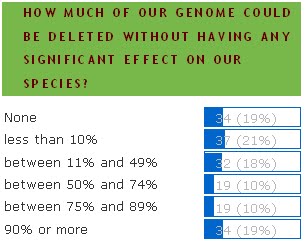
The issue has come up many times over the past few years on blogs and newsgroups. The last time I took a poll was a few years ago and here are the results.


As you can see, there's a wide range of opinion among people who read Sandwalk. I think this is a pretty good reflection of the opinions of most biologists.

In responding to the question, Wells makes one serious error when he claims that biologists promoted junk DNA because it "provides evidence for Darwinian evolution." It does nothing of the sort. In fact, it goes against any prediction of Darwinian evolution by natural selection. The reason why the concept of (huge amounts of) junk DNA was resisted by so many biologists was because of this conflict.

Wells also says that junk DNA was promoted by some biologists because it "provides evidence ... against intelligent design." This is partly true, especially when the arguments center on conserved pseudogenes. That part of junk DNA (pseudogenes) is accepted by almost all biologists but it's only a tiny part of our genome. There is no evidence to suggest that pseudogenes are anything but junk and all the evidence indicates that we have thousands of them in our genome. (If they have a function then they aren't pseudogenes.)

Many mainstream biologists have supported the idea that a majority of our genome is junk. There's no denying that. I agree with them. None of them are changing their minds in spite of what Jonathan Wells is telling you. What Wells is doing is picking sides in a genuine scientific dispute. He could have done this 30 years ago and the result would have been the same. The genuine scientific controversy is not about to be resolved and there's no new evidence that seals the case one way or the other.

In my opinion, our genome is almost 90% junk DNA and that's the view that's going to win in the end.