 This month's Carnival of Evolution is hosted by Stephen Matheson at Quintessence of Dust [Carnival of Evolution: #34].
It's the April 1, 2011 version but don't be fooled. Some of the postings are serious!
This month's Carnival of Evolution is hosted by Stephen Matheson at Quintessence of Dust [Carnival of Evolution: #34]. This is the second in a series of postings about a new book by Jonathan Wells: The Myth of Junk DNA. The book is published by Discovery Institute Press and it should go on sale on May 31 2011. I'm responding to an interview with Jonathan Wells on Uncommon Descent [Jonathan Wells on his book, The Myth of Junk DNA – yes, it is a Darwinist myth and he nails it as such].
Some people revise history by claiming that no mainstream biologists ever regarded non-protein-coding DNA as “junk.”It's in the best interests of the IDiots to promote the idea that all "Darwinists" believed in the "myth" of junk DNA and that it wasn't until the predictions of the IDiots were confirmed (not) that the biologists changed their minds.
This claim is easily disproved: Francis Crick and Leslie Orgel published an article in Nature in 1980 (284: 604-607) arguing that such DNA “is little better than junk,” and “it would be folly in such cases to hunt obsessively” for functions in it. Since then, Brown University biologist Kenneth R. Miller, Oxford University biologist Richard Dawkins, University of Chicago biologist Jerry A. Coyne, and University of California–Irvine biologist John C. Avise have all argued that most of our DNA is junk, and that this provides evidence for Darwinian evolution and against intelligent design. National Institutes of Health director Francis Collins argued similarly in his widely read 2006 book The Language of God.
It is true that some biologists (such as Thomas Cavalier-Smith and Gabriel Dover) have long been skeptical of “junk DNA” claims, but probably a majority of biologists since 1980 have gone along with the myth. The revisionists are misinformed (or misinforming).
 This is the first in a series of postings about a new book by Jonathan Wells: The Myth of Junk DNA. The book is published by Discovery Institute Press and it should go on sale on May 31 2011. I'm responding to an interview with Jonathan Wells on Uncommon Descent [Jonathan Wells on his book, The Myth of Junk DNA – yes, it is a Darwinist myth and he nails it as such].
“Non-coding” in this context means “non-protein-coding.” An important function of our DNA is to specific the sequences of subunits (amino acids) in the proteins that (along with other types of molecules) make up our bodies. When molecular biologists discovered in the 1970s that about 98% of our DNA does not code for proteins, some biologists called non-protein- coding DNA “junk.”This is misleading. You can consult the excellent article by Ryan Gregory on the origin of the term "junk DNA" to see what it meant in 1972: A word about "junk DNA". The bottom line is that the original meaning of the term "junk DNA" was much closer to what we now call pseudogenes. "Non-coding DNA" is that portion of the genome that does not encode amino acids. In the original paper by Susumu Ohno (1972) there was plenty of discussion about functional noncoding DNA (centromeres, regulatory sequences, spacer DNA). In addition, every scientist in 1972 knew that there were functional genes for tRNAs and ribosomal RNAs in the noncoding DNA.
According to Charles Darwin’s theory, all living things are descendants of common ancestors that have been modified solely by unguided natural processes that include variation and selection. In the modern version of his theory—neo-Darwinism— genes control embryo development, variations are due to differences in genes, and new variations originate in genetic mutations. In the 1950s, neo-Darwinists equated genes with DNA sequences (Francis Crick called DNA “the secret of life”) and assumed that their biological significance lay in the proteins they encoded. The 98% of our DNA that does not code for proteins was attributed to molecular accidents that have accumulated in the course of evolution.There's so much wrong with this answer that it's difficult to know where to begin. Maybe I'll just summarize in point form and elaborate in the comments if anyone wants to discuss it further.
“The amount of DNA in organisms,” neo-Darwinist Richard Dawkins wrote in 1976, “is more than is strictly necessary for building them: A large fraction of the DNA is never translated into protein. From the point of view of the individual organism this seems paradoxical. If the ‘purpose’ of DNA is to supervise the building of bodies, it is surprising to find a large quantity of DNA which does no such thing. Biologists are racking their brains trying to think what useful task this apparently surplus DNA is doing. But from the point of view of the selfish genes themselves, there is no paradox. The true ‘purpose’ of DNA is to survive, no more and no less. The simplest way to explain the surplus DNA is to suppose that it is a parasite, or at best a harmless but useless passenger, hitching a ride in the survival machines created by the other DNA.” (The Selfish Gene, p. 47)
Since the 1980s, however, and especially after completion of the Human Genome Project in 2003, biologists have discovered many functions for non-protein-coding DNA. If the Ming vase is a living cell and the leftover carpet nails are “junk DNA,” it turns out that the nails are not only made of gold, but they also make an essential contribution to the beauty of the vase.
 Denyse asks, "What caused the change of view about junk DNA? Can you suggest a couple of key findings?" And Wells replies,
In a word, evidence. The first to emerge was the fact that almost all of an organism’s DNA is transcribed into RNA. (So although most of it may be non-protein-coding, it codes for RNA.) From a Darwinian perspective, this is surprising: Why would an organism struggling to survive devote so many of its internal resources to producing supposedly useless RNA? Indeed, since 2003 it has become clear that non-protein-coding RNAs perform many essential functions in living cells.Among those of us who advocate junk DNA there are very few who have changed their minds in the past decade. Why is that? It's because we simply don't believe that the "evidence" of widespread transcription is meaningful. Those scientists who oppose the concept of plentiful junk DNA may have taken comfort from the transcription data but their minds weren't changed either. The truth is that there was, and is, a genuine scientific controversy and it has not been settled in spite of what the Intelligent Design Creationists tell you.
Pseudogenes constitute one type of so-called “junk DNA.” These are segments of DNA that resemble segments that elsewhere (or in other organisms) code for protein. Yet RNAs transcribed from some pseudogenes have been found to function in regulating how much protein is produced by the DNA segments they resemble.Even if you added up all of the known examples of this phenomenon from every investigated species and stuffed them into a single genome it wouldn't amount to more than 0.01% of the genome. And there's no reason to think that the phenomenon is anything more than an interesting exception.
Repetitive DNA, in which a non-protein-coding sequence is repeated many times, is another type of so-called “junk DNA.” Yet repetitive DNA is now known to regulate many essential functions, including embryo implantation in mammals.Also misleading. A few examples from diverse species do not make a difference. Indeed these exceptions tend to "prove the rule" rather than overthrow it. Wells is deliberately misleading his audience but he's in good company since there are many scientists who do the same thing. In order to have a serious impact on the junk DNA debate it's not sufficient to show that a few bits of repetitive DNA have gained a function in some species. You have to show that this generalizes to the 50% of the genome that's made up of repeated DNA of various sorts.
There is also growing evidence that non-protein-coding DNA can perform functions that are independent of its sequence. One example is the region of a chromosome (called a “centromere”) that attaches it to other structures in the cell. Another example is the retina in the eyes of nocturnal mammals, in which non-protein-coding DNA acts like a liquid crystal to focus scarce rays of light.There are many known functions of noncoding DNA. They've been known for decades. As a general rule, the proponents of junk DNA seem to be better informed about these regions of the genome than their opponents. It hasn't made a difference in the past and it doesn't now. (Centromeres account for about 2% of the genome. They fall into the 10% that's known not to be junk.)
 Denyse's last question is about me. "Can you interpret this for me, from Larry Moran (University of Toronto evolutionary biologist): “I don’t demand civility, but I do demand accuracy. When Denyse and her friends say that Darwinists promoted junk DNA I have to draw the line.” But he must be referring to my observation that originated in Francis Collins’s (US government’s chief 2000 genome mapper’s [!]) statements in a well-received and widely read book. Are there two types of truths at work here? Evidence, and … what? "
When I use the term “Darwinist,” I mean someone who accepts and defends the theory I describe in my answer to Question 2. Crick and Orgel were Darwinists in this sense; so are Miller, Dawkins, Coyne, and Avise—all of whom have promoted the myth of junk DNA. When Collins published The Language of God in 2006, he not only promoted junk DNA but also wrote that “Darwin’s theory of evolution, that is, descent from a common ancestor with natural selection operating on randomly occurring variations” is “unquestionably correct” (pp. 127, 141). Sure sounds like a Darwinist to me.Several of these scientists have written about pseudogenes and the fact that their existence provides strong support for evolution and strong evidence against the existence of an intelligent designer. Most (all?) biologists understand that pseudogenes are an example of junk DNA. Wells has chosen the one example of junk DNA where there's an overwhelming consensus. They are junk.
Collins also wrote that intelligent design is a “God of the gaps” position that is doomed to collapse with further advances in science (p. 193). But Collins has it exactly backwards: He and other promoters of the myth of junk DNA have put their faith in a “Darwin of the gaps” argument that must now retreat in the face of new advances in genome research.
 But that's not what the scientific debate is about. Pseudogenes are not a myth. They are a fact, and they make up as much as 2% of the mammalian genome. The scientific debate is about whether most of our genome is really junk DNA. I think Francis Collins supports this idea, with some reservations, but I don't know about Jerry Coyne or Kenneth Miller or Richard Dawkins. John Avise is, of course, one the main proponents of junk DNA being a majority of our genome. His book Inside the Human Genome: A Case for Non-intelligent Design was published just last year (2010). It's for those needing an antidote after reading the upcoming train wreck by Jonathan Wells.
Okay, everyone, back to work tomorrow in Darwinworld, where facts like these do not matter in the least.That's why I call them "IDiots." Facts matter to real scientists. The tough part about being a scientist is deciding what's a fact and what's not. Well showed us that he was not up to the task of behaving like a real scientist when he wrote Icons of Evolution and I suspect he's about to provide us with another example of misinformation and selective reading of the scientific literature.
1. Dawkins recognizes that there is some junk in our genome—pseudogenes are a good example—but that does not mean he buys into the idea that a huge percentage of our genome is just junk.
September 9, 2004
Her Excellency the Right Honourable Adrienne Clarkson,
C.C., C.M.M., C.O.M., C.D.
Governor General
Rideau Hall
1 Sussex Drive
Ottawa, Ontario K1A 0A1
Excellency,
As leaders of the opposition parties, we are well aware that, given the Liberal minority government, you could be asked by the Prime Minister to dissolve the 38th Parliament at any time should the House of Commons fail to support some part of the government’s program.
We respectfully point out that the opposition parties, who together constitute a majority in the House, have been in close consultation. We believe that, should a request for dissolution arise this should give you cause, as constitutional practice has determined, to consult the opposition leaders and consider all of your options before exercising your constitutional authority.
Your attention to this matter is appreciated.
Sincerely,
Hon. Stephen Harper, P.C., M.P.
Leader of the Opposition
Leader of the Conservative Party of Canada
Gilles Duceppe, M.P.
Leader of the Bloc Quebecois
Jack Layton, M.P.
Leader of the New Democratic Party
[Hat Tip: Ryan Gregory]
Intelligent design has as much to offer to the unbeliever or the unorthodox searcher as to the confirmed traditional believer. It might even have more. Does that surprise you?Wow! That's what I call real NEWS for evolution. The idea that intelligent design might actually have nothing to do with a creator is truly astonishing.
Could it be a trend, with critics of intelligent design and others outside the familiar world of ID's friends and advocates at last realizing that ID isn't merely NOT the same thing as creationism? More than that, a couple have noted lately, intelligent design isn't necessarily even theistic.
Every real solution to this problem of despair assumes a reality beyond our mundane, one-dimensional and material one. How could it not? We are in despair, or fear falling into it -- whether we're religious or otherwise -- over the limitations of our own lives.This is why philosophy is so confusing. Let's see if I've grasped the logic here. Intelligent design is anti-materialistic but not religious. It implies the existence of "something" that is out there that gives David Klinghoffer some sort of purpose in life and makes him feel less afraid of death. That "something" can't be God because intelligent design isn't necessarily theistic.
The ultimate limit is imposed by death, which we fear as no generation in memory seems to have done despite the overwhelming safety of our existence. In the meantime, while we are still alive, the lack of a sense of ultimate purpose and meaning that goes with the culture of materialism feeds the anxiety that underlies so much of that culture.
Materialism corrodes the confidence we might otherwise have that any search for meaning that we undertake is not necessarily in vain. Intelligent design offers the hope, by the refutation of materialist science, that "something is out there," whatever it might be, capable of granting genuine purpose to our existence. An agnostic like James Kirk Wall or a -- I don't know what exactly -- like Jack Scanlan should easily appreciate this.
 Yesterday the Canadian government under Stephen Harper was defeated for contempt of parliament [Canadian Government Falls]. This is the first time that this has happened in the history of the British Commonwealth.
This government is very transparent. When we look at the Conservatives, we know exactly what they are thinking. We can see right through them. Quite apart from the image they like to project, if you look closely, you can see right through them. The Minister of State for Science and Technology is a creationist and believes that dinosaurs walked the earth with humans. He thinks that The Flintstones was a documentary and Dino was the star. We can see their old Reform roots, which are likely what inspired the Tea Party.This actually resonates within the House of Commons and with Canadians. Creationists don't get much respect in Canada.
 This is how a parliamentary system of government works.
Mr. Ignatieff (Etobicoke—Lakeshore) — That the House agree with the finding of the Standing Committee on Procedure and House Affairs that the government is in contempt of Parliament, which is unprecedented in Canadian parliamentary history, and consequently, the House has lost confidence in the government.This was immediately followed by a motion from the Prime Minister to adjourn the House. That motion carried.
1. Officially, the Governor General is the Canadian representative of the Queen of Canada who lives in the United Kingdom. The Governor General will not be phoning the Queen to ask her advice. The current Governor General is His Excellency the Right Honourable David Johnston.
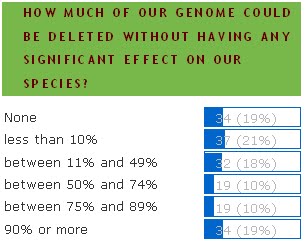
 The earliest direct estimates of the size of human genome clustered around 3,000 Mb (megabase pairs) or 3.0 ×10⁹ bp (base pairs). The textbooks settled on about 3,200 Mb based mostly on reassociation kinetics. According to those results from the 1970s, roughly 10% of the genome consists of highly repetitive DNA, 25-30% is moderately repetitive and the rest is unique sequence DNA.
1. In the interests of fairness, I should note that there are a great many evolutionists who also don't understand punctuated equilibria. I'm really posting this video for them and not for the creationists.
[Hat Tip: Greg Laden]
 One of the cool things about studying your genealogy is that you can find connections to almost everyone. This means you can celebrate dozens of special days. In my case it was easy to find ancestors from England, Scotland, Netherlands, Germany, France, Spain, Poland, Lithuania, Belgium, Ukraine, Russia, United States, and, of course, Ireland.
1. You don't have to be Irish or have Irish ancestors to celebrate St. Patrick's Day.

 PZ Myers on Salon reviews a book that I'm never going to read [David Brooks' dream world for the trust-fund set]. Unfortunately he uses language and style that's probably far above the heads of those who need convincing. But it's loads of fun.
 I made it almost a third of the way through the arid wasteland of David Brooks' didactic novel, "The Social Animal: The Hidden Sources of Love, Character, and Achievement," before I succumbed. I had begun reading it determined to be dispassionate and analytic and fair, but I couldn't bear it for long: I learned to loathe Harold and Erica, the two upscale avatars of upper-middle-class values that Brooks marches through life in the story. And then I began to resent the omniscient narrator who narrates this exercise in unthinking consumption and privilege that is, supposedly, the ideal of happiness; it's like watching a creepy middle-aged man fuss over his Barbie and Ken dolls, posing them in their expensive accessories and cars and houses and occasionally wiggling them in simulated carnal relations (have no worries, though: Like Barbie and Ken, no genitals appear anywhere in the book), while periodically pausing to tell his audience how cool it all is, and what is going on inside his dolls' soft plastic heads.
I did manage to work my way through the whole book, however, by an expediency that I recommend to anyone else who must suffer through it. I simply chanted to myself, "Die, yuppie scum, die," when I reached the end of each page, and it made the time fly by marvelously well. In addition, there is a blissful moment of catharsis when you reach the last page and one of the characters does die, although it isn't in a tragic explosion involving a tennis racket, an overdose of organic fair-trade coffee, and an assassination squad of rogue economists at Davos, as I was hoping. That's not a spoiler, by the way; the book is supposed to be all about the happy, productive life histories of Harold and Erica, from birth to death, so it's no surprise that at least one dies. It is incomplete, in that the other one survives ... an unsatisfying ending that I could happily resolve with one more bloody page, and that represents the only case I can imagine in which I'd ever ask David Brooks to write another word.
 Ontario has two schools systems—both publicly funded. The "public schools" are open to all comers but the "Roman Catholic" ("Separate") school system isn't.
The organizations represented by the One School System Network [OSSN] are united in the conviction that:Here's one of the reasons why we need to merge the Roman Catholic schools into a single, secular, public school system: Students sent home.
Ontario's publicly funded school system bring students of all backgrounds together in an environment that fosters mutual respect and understanding while respecting their fundamental equality and helping them to realize their full potential as citizens.
To realize that vision, OSSN seeks the establishment of a single secular school system for each official language, namely English and French public school boards.
Furthermore, OSSN seeks the elimination of costly duplication in the Ontario school system in order to minimize infrastructure costs and to maximize opportunities for student development.
Publicly funded schools in Ontario shall not discriminate on the basis of religion in any form including: school environment, enrolment of students, opportunities for all students, evaluation of students, employment and advancement of teachers and all other school board personnel, adherence to Ministry of Education curriculum guidelines including courses in World and Comparative Religions.
Publicly funded school boards may, where appropriate, permit voluntary religious programs for students provided by local faith groups outside regular instructional hours.

Alexandria Szeglet added a strip of green tape to her St. Patrick High School uniform Thursday with the word “choice” written on it and was sent home for the day after refusing to take it off.Alexandria and about 35 other students were send home for wearing the green tape. None of the students who wore red tape with the word "life" were sent home or asked to remove the tape.
The Grade 10 student wore the green tape in response to a pro-life event at the school, where some students wore a red piece of tape with “life” written on it and didn’t talk for the day to display their belief in the injustice of abortion.
Ann says:John de Faveri is the director of education for the Thunder Bay Catholic District School Board.
Alexandria is my daughter. Her father and I are raising and guiding her and her sister into formulating independent thought and opinion. Alex went to school today wearing a green piece of tape in response to a pro-life scheduled event that she knew was already happening. It was JUST a piece of tape. Very quickly, she was informed that she wasn't allowed to imply her opinion ~ but others wearing "red" were. "Pro-choicers", like Alex, believe in simply that. If a woman chooses abortion, then Alex would support that. If a woman chooses to have the child, Alex would support that too. I know for a fact that she did this not expecting the out pouring of support she has been receiving, but to just put her opinion out there like all the rest. This IS a very touchy subject with a lot of people, and knowing that the School Board allows this in their halls ... I'm speechless. We're very proud of you, Alex.
Kerri says:
Alexandria is my niece and we are very proud of her ability to speak her own mind. This demonstration was done peacefully and without malice unlike some of the pro life demonstrations that have happened in the past. I am born and raised a Catholic woman, am well educated. Having attended a Catholic school myself, I am appaled at the ridiculousness of this situation and the stand that the school and school board have taken on this subject when Alex simply held true to her beliefs. Isn't that what we teach our children? To have independence, a mind of their own and to be secure in all the decisions they make?
Ask yourself this question: Would you want to be the person to explain who your childs dad was if you were a victim of rape or incest? OR What if your life was in mortal danger? PRO CHOICE means just that...a woman's choice. It's not a form of birth control nor is it a decision any woman would want to make. I know in my heart and in my wonderful niece's heart that she is intelligent enough to know what is right or wrong for her own self. We are proud of her if every sense and we will continue to support her throughout her life. It's a shame that the world is still stuck in the dark ages and that a woman still does not have the right to choose...This is a touchy subject that someone thought was ok for high schoolers to demonstrate...with the advent of Facebook and social media, what did they think would happen when people caught wind of today's events?
“On the issue, pro-life is part of the Catholic stand,” said de Faveri during a phone interview with Dougall Media Thursday afternoon. “The pro-choice students were not appropriate in the context of a Catholic school.”That's exactly why we need to convert all these schools into secular schools.
[Hat Tip: Canadian Atheist: The easiest way to get kicked out of Catholic school…]
 Sometimes it's a good idea to let the other side have a say. It can be very revealing. This is from The Epistemological Deficiencies of Barbara Forrest. It's written by DonaldM.
Denyse O’Leary writes about Barbara Forrest’s fact-free attack on Frank Beckwith, which recently appeared in Synthese. While Denyse focused more on Beckwith’s response to Forrest’sSo now you know. The intelligent designer doesn't have to be God. It could be the Wizard of Oz or aliens from Betelgeuse.scholarly articlediatribe, it might be worth taking a closer look not only at Forrest’s article, but the entire issue of Synthese in which it is found. First Forrest. In the abstract for her article with the breathtaking title “The non-epistemology of intelligent design: its implications for public policy”, Bar writes:Intelligent design creationism (ID) is a religious belief requiring a supernatural creator’s interventions in the natural order. ID thus brings with it, as does supernatural theism by its nature, intractable epistemological difficulties.Okay, so we’re only 2 sentences into the abstract and we can already see that Bar has no clue what ID is about. I don’t know what ID books or articles she’s actually read, but claiming that ID is a “religious belief requiring a supernatural creator’s intervention” demonstrates how little she understands ID. Perhaps Bar could enlighten us as to what religion ID adheres. Since ID advocates come from a broad range of faith traditions as well as no faith tradition at all, it would seem a bit problematic for her to identify exactly which religion we’re talking about here. Further, I know of no ID advocate that makes the claim that ID “requires” a “supernatural” creator. While ID may be compatible with certain theistic beliefs, it by no means requires it. If Forrest has done even a cursory review of any ID literature she’d know that. (Actually, I suspect she does know that, but because she has a clear agenda, she fudges on the truth.)
Whenever I see the phrase “Intelligent Design creationism”, red flags go up all over the place. This traces back to Intelligent Design Creationism and Its Critics, a ponderous tome from 2001 edited by Robert Pennock, and in which Forrest herself had a chapter. The clever illusion of the title is to give the appearance of an unbreakable link between Intelligent Design and Creationism, no doubt because the term “creationism” carries with it the allusions to young earth creationism and all that goes with that. To Pennock and Forrest et.al., Intelligent Design is just a modifier for Creationism. But any informed reader already knows something is amiss when we see that phrase.


